

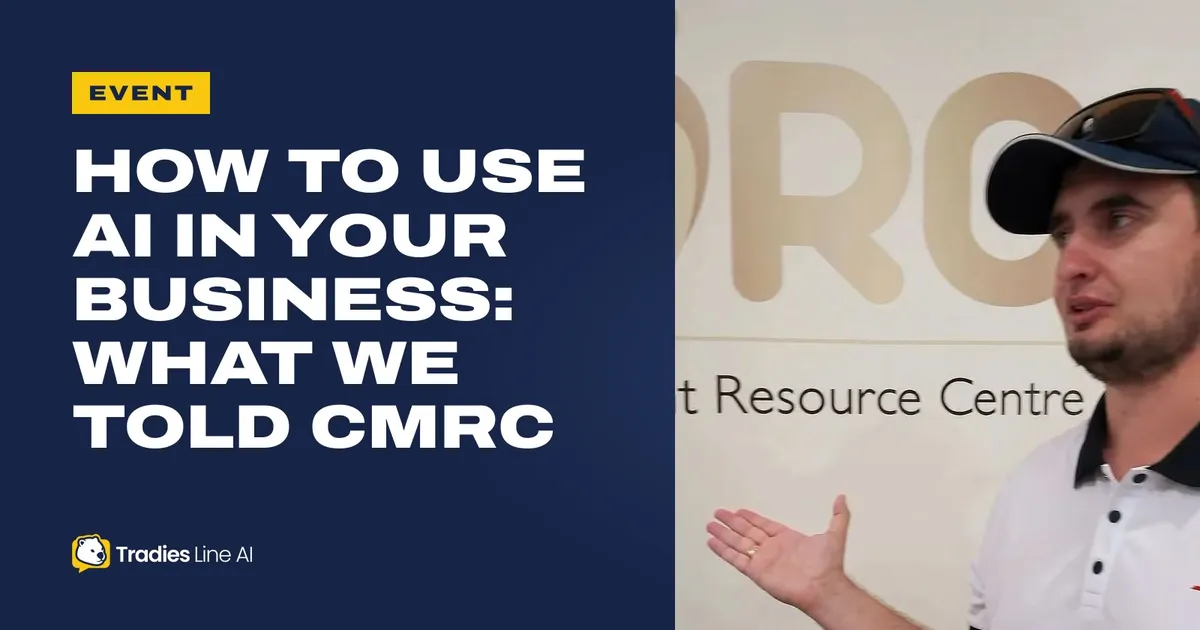
Give AI the repetitive work and keep every final decision with a person. That is how we launched Tradies Line AI, as Serge told the CMRC AI for Business workshop at Top Ryde on 14 November 2026.
To use AI in your business, give it the repetitive work: research, first drafts, answering calls and chasing unpaid invoices. Keep the customer relationship and every final decision with a person, so AI does the work and a person says yes. That is how to use AI in your business without losing control of it. It was the rule behind the opening talk Serge Chyzhyk, our co-founder and CEO, gave at the AI for Business workshop. The Community Migrant Resource Centre (CMRC) ran the workshop at Top Ryde City on Saturday 14 November 2026.
Tradies Line AI is the AI office for trades businesses in Australia and New Zealand. The talk was called From Idea to First Customers. It walked through how we launched Tradies Line AI step by step, showing where AI did the work and where people did.
How to use AI in your business: where did AI do the work and where did people?
The short version from the talk:
AI agents did: the market research, writing the app and the website, the AI phone line, testing every screen, video scripts and running the ads.
People did: ringing tradies, earning their trust, approving every change and making the final calls.
Why did a leaking kitchen turn into a business for plumbers and electricians?
The idea came from Serge's own kitchen. Back from a holiday, Serge found water all over the floor and rang three plumbers from the list on the fridge.
Two of the plumbers did not answer. The third picked up, said "call me back when I've picked up my kid", and hung up. It was an urgent job with money ready to pay, and nobody took it.
The leak damaged the cabinet under the sink and the skirting boards, and we could not get anyone out fast. The lesson the talk drew: every missed call is a lost job. We wrote more on that in what actually happens when you miss a call.
Finding the idea still took several turns in 2026. We started with AI for cleaning businesses in April and switched to tradies in May. Then we tried every trade at once, which was too broad.
In September we narrowed to plumbers and electricians. Their calls are urgent, a burst pipe or no power, and whoever answers first gets the job.
How do you test a business idea before you build it?
The talk gave four questions for testing an idea:
Does the problem happen every week?
Is the market big enough?
Does someone already sell a fix?
Do investors fund it?
Competitors are not a red flag: they prove the market.
What can AI agents research for a small business?
Step one was market research. AI agents read nine competitors' websites and prices. They read those competitors' customer reviews for complaints, and pulled official business counts for Australia and New Zealand.
Then we rang tradies ourselves to check every finding. Talking to customers, earning their trust and making the final call stayed with people. An AI can read every review. It cannot earn a tradie's trust on the phone.
Can AI build the product, and who checks it?
Step two was building the product. People design how the parts fit together. AI agents write the app, the website and the AI phone line, and test every screen on a phone, a tablet and a computer.
Real tradies try each change, and nothing reaches customers without our yes. One technical founder working with AI agents built the product in about seven months.
What happened when the first ads did not work?
Step three was the first customer. A week of picture ads with Wombo, our wombat, brought no sign-ups.
So we went to an event for trades business owners to listen to how they talk about their work. We heard the word that sells there: system.
An AI agent wrote a video script around it, "You are the system", read by an AI avatar made in HeyGen. An AI ads agent built a quiz form and launched the ads. That brought a paying customer, won for A$62 in ad spend.
The AI did the writing and the launching. The word itself came from people listening in a room.
How do you run a company with a team of AI agents?
We run the company with a team of AI agents arranged like an org chart:
a general manager we talk to
a technical lead connected to the code and the live product
agents for accounting and legal paperwork
agents for ads, scripts, videos and search
People sit at the top of that chart. Serge and Anna, our co-founder, set the tasks and approve the results.
Every agent reads the same product documentation, so they all describe the product the same way. If you hand work to more than one AI tool, give them all the same written facts about your business.
What does the same idea look like for a tradie's office?
The talk then showed the same idea built for a tradie. It is an AI office that takes every call, text and message while the owner stays on the tools. Wombo is the AI office manager. The talk ended with a live demo: a phone call to Wombo in front of the room.
Here is what that office does today. The AI receptionist answers the calls you can't take, on the number your customers already ring. It finds out the job and the suburb, and books it into your calendar when booking is on. Urgent jobs are texted to you while the caller is still on the line, if your number is verified and you have texts left.
You type or talk to Wombo, the AI office manager. Ask "who owes me money?" and you get your overdue invoices. Ask for a quote and Wombo drafts it from your own price list.
AI quoting builds the whole quote from your voice notes, photos and plans on site. Every line names the note it came from. AI invoicing drafts the invoice with a pay link and, with reminders on, chases the unpaid ones.
The rule from the talk holds: AI builds the quote and drafts the invoice, and you check and send both. No quote or invoice goes to a customer until you send it.
Where should a plumber or electrician start with AI this week?
The lesson from the talk was that every missed call is a lost job, so start with the calls you miss.
List your pain points. The NZ business.govt.nz pilot guide, reviewed March 2026, suggests writing down 5 to 10 pain points, such as what feels repetitive.
Pick one or two. The Australian business.gov.au AI page says to start by trialling AI in 1 or 2 areas of your business.
Keep the yes. The same business.gov.au page says AI tools need human oversight to work safely, so review the output before it goes out.
Forward only the calls you miss. Our call forwarding guide has each carrier's codes, so your number stays yours.
There is free official guidance on each side of the Tasman, and the two are separate. In October 2025, Australia's National AI Centre released its Guidance for AI Adoption with six practices. It comes with an AI policy template and an AI register template. In New Zealand, MBIE's Responsible AI Guidance for Businesses is voluntary and covers all New Zealand businesses, sole traders included.
Ten days before CMRC, on 4 November 2026, we demoed at Atlassian for Startups: Demo Night in Sydney. We were one of five startups picked from more than fifty applicants.
How Tradies Line AI helps with this
Tradies Line AI is the AI-does-the-work, you-say-yes rule built for a plumbing or electrical office. The AI receptionist answers the calls you miss, Wombo drafts quotes and invoices, and AI invoicing chases what is unpaid. You check and send every quote and invoice.
The Free plan is $0 a month, with no card, no time limit and 5 lifetime test calls to hear the AI receptionist. When you want real calls answered, Starter is $97 a month for 50 answered calls, plus GST for Australian businesses. Sign up free and set it up from the dashboard.
Tradies Line AI is built in Sydney by Serge and Anna Chyzhyk.
Common questions
How do you use AI in your business without losing control of it?
Give AI the repetitive work, such as research, drafts, answering calls and chasing, and have a person approve every final decision. The business.gov.au AI page says AI tools need human oversight to work safely.
Is there free government guidance on AI for Australian small businesses?
Yes. In October 2025 the National AI Centre released its Guidance for AI Adoption. It includes an AI policy template and an AI register template.
Is there AI guidance for New Zealand businesses?
Yes. MBIE's Responsible AI Guidance for Businesses is voluntary and covers all New Zealand businesses, including sole traders. The business.govt.nz pilot guide walks through a first trial.
Does Tradies Line AI send quotes and invoices on its own?
No. AI builds the quote and drafts the invoice, and you check and send them. No quote or invoice goes to a customer until you send it.
Which job should a plumber or electrician hand to AI first?
The missed call. Urgent jobs like a burst pipe or no power go to whoever answers first. An AI receptionist on the calls you miss is the place to start.
Ready to hand the office over?
Jobs, quotes, invoices and every customer message in one place, with Wombo, your AI office manager, doing the admin while you're on the tools. Free to start, no card.